Basic Usage Examples
This notebook demonstrates the key functions in the instate package for predicting Indian states and languages from last names.
Overview
The instate package provides two main approaches:
Electoral Rolls Lookups - Fast frequency-based lookups from Indian electoral rolls data (2017)
Neural Network Predictions - Machine learning models for enhanced predictions
Let’s explore each approach with practical examples.
Setup
First, let’s import the necessary modules and set up our examples.
[1]:
import instate
import pandas as pd
import matplotlib.pyplot as plt

# Sample Indian last names for demonstration
sample_names = ['sood', 'dhingra', 'kumar', 'patel', 'singh', 'sharma', 'reddy', 'iyer']

print(f"instate version: {instate.__version__}")
print(f"Sample names: {sample_names}")
instate version: 1.2.0
Sample names: ['sood', 'dhingra', 'kumar', 'patel', 'singh', 'sharma', 'reddy', 'iyer']
Electoral Rolls Lookups
The electoral rolls approach provides frequency-based lookups for names found in the 2017 Indian electoral rolls dataset.
Get State Distribution
The get_state_distribution function returns the probability distribution P(state|lastname) based on electoral rolls data.
[2]:
# Get state distributions for our sample names
state_dist = instate.get_state_distribution(sample_names)

print("State distributions from electoral rolls:")
print("="*50)

# Get state columns (exclude the name column)
name_col = state_dist.columns[0]
state_columns = [col for col in state_dist.columns if col != name_col]

for i, row in state_dist.iterrows():
    name = row[name_col]
    print(f"\n{name.upper()}:")

    # Get non-zero state probabilities for this name
    state_probs = []
    for state_col in state_columns:
        prob = row[state_col]
        if pd.notna(prob) and prob > 0:
            state_probs.append((state_col, prob))

    if state_probs:
        # Show top 3 states for each name
        sorted_states = sorted(state_probs, key=lambda x: x[1], reverse=True)[:3]
        for state, prob in sorted_states:
            # Clean up state name for display
            display_state = state.replace('_', ' ').title()
            print(f"  {display_state}: {prob:.3f}")
    else:
        print("  Not found in electoral rolls")
Copying electoral rolls data from package...
State distributions from electoral rolls:
==================================================

SOOD:
  Total N: 29403.000
  Punjab: 0.365
  Himachal Pradesh: 0.225

DHINGRA:
  Total N: 7519.000
  Delhi: 0.534
  Punjab: 0.233

KUMAR:
  Total N: 28103693.000
  Uttar Pradesh: 0.408
  Bihar: 0.217

PATEL:
  Total N: 808394.000
  Maharashtra: 0.371
  Uttar Pradesh: 0.167

SINGH:
  Total N: 30446816.000
  Uttar Pradesh: 0.297
  Punjab: 0.224

SHARMA:
  Total N: 3356158.000
  Uttar Pradesh: 0.275
  Bihar: 0.244

REDDY:
  Total N: 583131.000
  Andhra Pradesh: 0.632
  Telangana: 0.326

IYER:
  Total N: 624.000
  Tamil Nadu: 0.314
  Delhi: 0.260
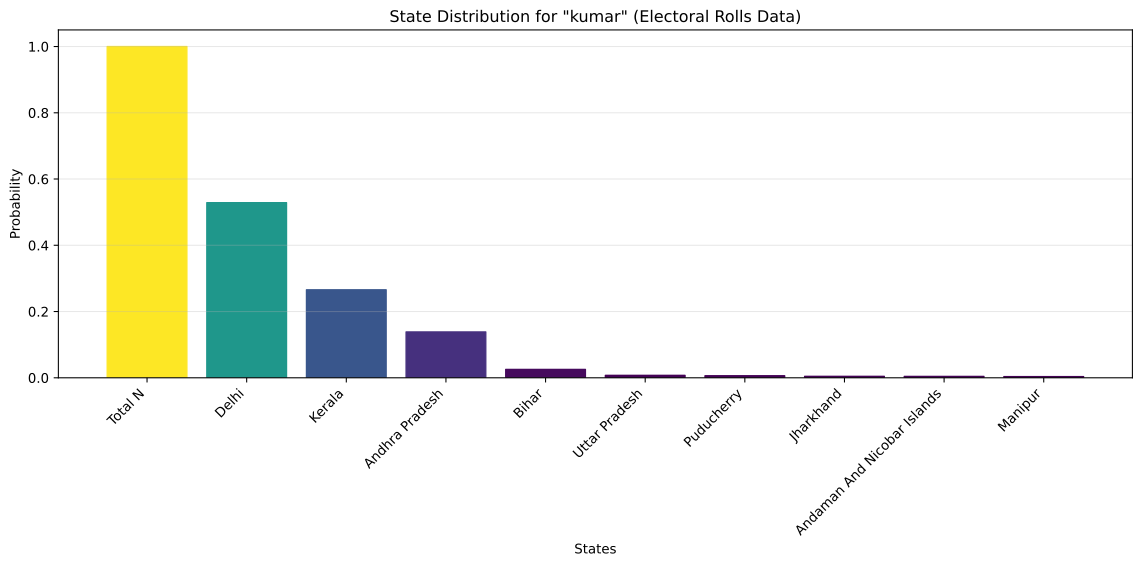
Visualize State Distribution
Let’s create a visualization for one of the names with the richest state distribution.
[3]:
# Pick a name with good state distribution for visualization
name_to_plot = 'kumar'  # This is typically found in multiple states

# Find the row for this name in our results
name_row = state_dist[state_dist.iloc[:, 0] == name_to_plot]

if not name_row.empty:
    row = name_row.iloc[0]

    # Get non-zero state probabilities for visualization
    state_probs = []
    name_col = state_dist.columns[0]
    state_columns = [col for col in state_dist.columns if col != name_col]

    for state_col in state_columns:
        prob = row[state_col]
        if pd.notna(prob) and prob > 0:
            state_probs.append((state_col, prob))

    if state_probs:
        # Get top 10 states for plotting
        sorted_states = sorted(state_probs, key=lambda x: x[1], reverse=True)[:10]
        states, probabilities = zip(*sorted_states)

        # Clean up state names for display
        display_states = [state.replace('_', ' ').title() for state in states]

        # Create bar plot
        plt.figure(figsize=(12, 6))
        bars = plt.bar(range(len(display_states)), probabilities)
        plt.xlabel('States')
        plt.ylabel('Probability')
        plt.title(f'State Distribution for "{name_to_plot}" (Electoral Rolls Data)')
        plt.xticks(range(len(display_states)), display_states, rotation=45, ha='right')

        # Color bars by probability
        if probabilities:
            max_prob = max(probabilities)
            for i, bar in enumerate(bars):
                bar.set_color(plt.cm.viridis(probabilities[i] / max_prob))

        plt.tight_layout()
        plt.grid(axis='y', alpha=0.3)
        plt.show()
    else:
        print(f"'{name_to_plot}' has no state distribution data")
else:
    print(f"'{name_to_plot}' not found in results")
Get State Languages
The get_state_languages function maps states to their official languages.
[4]:
# Get languages for some specific states
states_to_check = ['Maharashtra', 'Punjab', 'Tamil Nadu', 'West Bengal', 'Gujarat']

print("State to Languages Mapping:")
print("="*40)

# Pass the list of states to get_state_languages
state_languages = instate.get_state_languages(states_to_check)

# Display the results
for i, row in state_languages.iterrows():
    state = row.iloc[0]  # First column is the state
    if len(row) > 1 and 'official_languages' in state_languages.columns:
        languages = row['official_languages']
        if pd.notna(languages):
            print(f"{state}: {languages}")
        else:
            print(f"{state}: No language data available")
    else:
        print(f"{state}: No language data available")
State to Languages Mapping:
========================================
Maharashtra: Marathi
Punjab: Punjabi
Tamil Nadu: Tamil
West Bengal: Bengali, English
Gujarat: Gujarati
List Available States
See all states available in the electoral rolls dataset.
[5]:
# Get all available states
available_states = instate.list_available_states()

print(f"Total states available: {len(available_states)}")
print("\nAvailable states:")
print("="*50)

# Print states in columns for better readability
for i, state in enumerate(sorted(available_states), 1):
    print(f"{i:2d}. {state}")
Total states available: 35

Available states:
==================================================
 1. Andaman and Nicobar Islands
 2. Andhra Pradesh
 3. Arunachal Pradesh
 4. Assam
 5. Bihar
 6. Chandigarh
 7. Dadra and Nagar Haveli
 8. Daman and Diu
 9. Delhi
10. Goa
11. Gujarat
12. Haryana
13. Himachal Pradesh
14. Jammu and Kashmir and Ladakh
15. Jharkhand
16. Karnataka
17. Kerala
18. Madhya Pradesh
19. Maharashtra
20. Manipur
21. Meghalaya
22. Mizoram
23. Nagaland
24. Odisha
25. Puducherry
26. Punjab
27. Rajasthan
28. Sikkim
29. Tamil Nadu
30. Telangana
31. Tripura
32. Uttar Pradesh
33. Uttarakhand
34. West Bengal
35. total_n
Neural Network Predictions
For names not in electoral rolls or for enhanced predictions, the package provides neural network models.
Predict States
The predict_state function uses GRU neural networks to predict likely states.
[6]:
# Predict states for our sample names
try:
    state_predictions = instate.predict_state(sample_names, top_k=3)

    print("Neural Network State Predictions:")
    print("="*50)

    for i, row in state_predictions.iterrows():
        name = row.iloc[0]  # First column is the name
        predictions = row['predicted_states']
        print(f"\n{name.upper()}:")
        for j, state in enumerate(predictions, 1):
            print(f"  {j}. {state}")
except Exception as e:
    print(f"State prediction error: {e}")
    print("Note: Neural network models may require additional setup or trained weights.")
Neural Network State Predictions:
==================================================

SOOD:
  1. Himachal Pradesh
  2. Delhi
  3. Punjab

DHINGRA:
  1. Delhi
  2. Uttar Pradesh
  3. Haryana

KUMAR:
  1. Uttar Pradesh
  2. Bihar
  3. Rajasthan

PATEL:
  1. Maharashtra
  2. Bihar
  3. Madhya Pradesh

SINGH:
  1. Uttar Pradesh
  2. Punjab
  3. Bihar

SHARMA:
  1. Uttar Pradesh
  2. Bihar
  3. Rajasthan

REDDY:
  1. Andhra Pradesh
  2. Telangana
  3. Tamil Nadu

IYER:
  1. West Bengal
  2. Kerala
  3. Maharashtra
Predict Languages
The predict_language function predicts likely languages using LSTM or KNN models.
[7]:
# Predict languages using different models
print("Language Prediction Examples:")
print("="*50)

# Try LSTM model first
try:
    print("\nTrying LSTM model...")
    language_predictions_lstm = instate.predict_language(sample_names, model='lstm', top_k=3)

    print("\nNeural Network Language Predictions (LSTM):")
    print("-" * 50)

    for i, row in language_predictions_lstm.iterrows():
        name = row.iloc[0]  # First column is the name
        pred_langs = row['predicted_languages']
        print(f"\n{name.upper()}:")
        if isinstance(pred_langs, list):
            for j, lang in enumerate(pred_langs[:3], 1):
                print(f"  {j}. {lang}")
        else:
            print(f"  1. {pred_langs}")

except Exception as e:
    print(f"LSTM model not available: {e}")
    print("\nTrying KNN model...")

    try:
        language_predictions_knn = instate.predict_language(sample_names, model='knn', top_k=3)

        print("\nNeural Network Language Predictions (KNN):")
        print("-" * 50)

        for i, row in language_predictions_knn.iterrows():
            name = row.iloc[0]  # First column is the name
            pred_langs = row['predicted_languages']
            print(f"\n{name.upper()}:")
            if isinstance(pred_langs, list):
                for j, lang in enumerate(pred_langs[:3], 1):
                    print(f"  {j}. {lang}")
            else:
                print(f"  1. {pred_langs}")
    except Exception as e2:
        print(f"KNN model also not available: {e2}")
        print("Note: Language prediction requires trained models to be available.")
Language Prediction Examples:
==================================================

Trying LSTM model...

Neural Network Language Predictions (LSTM):
--------------------------------------------------

SOOD:
  1. hindi
  2. punjabi
  3. urdu

DHINGRA:
  1. hindi
  2. punjabi
  3. urdu

KUMAR:
  1. hindi
  2. urdu
  3. punjabi

PATEL:
  1. hindi
  2. marathi
  3. urdu

SINGH:
  1. hindi
  2. punjabi
  3. urdu

SHARMA:
  1. hindi
  2. urdu
  3. punjabi

REDDY:
  1. telugu
  2. urdu
  3. tamil

IYER:
  1. bengali
  2. malayalam
  3. hindi
Comparative Analysis
Let’s compare the electoral rolls data with neural network predictions for names found in both systems.
[8]:
print("Comparison: Electoral Rolls vs Neural Network Predictions")
print("="*65)

# Get name and state columns for easier access
name_col = state_dist.columns[0]
state_columns = [col for col in state_dist.columns if col != name_col]

for name in sample_names:
    print(f"\n{name.upper()}:")

    # Electoral rolls top state
    name_row = state_dist[state_dist[name_col] == name]
    if not name_row.empty:
        row = name_row.iloc[0]

        # Find the state with highest probability
        max_prob = 0
        top_state = None
        for state_col in state_columns:
            prob = row[state_col]
            if pd.notna(prob) and prob > max_prob:
                max_prob = prob
                top_state = state_col.replace('_', ' ').title()

        if top_state:
            print(f"  Electoral Rolls Top State: {top_state} ({max_prob:.3f})")
        else:
            print(f"  Electoral Rolls: Not found")
    else:
        print(f"  Electoral Rolls: Not found")

    # Neural network top state (if available)
    try:
        # Find the row for this name in the predictions
        name_rows = state_predictions[state_predictions.iloc[:, 0] == name]
        if not name_rows.empty:
            nn_top_state = name_rows.iloc[0]['predicted_states'][0]
            print(f"  Neural Network Top State:  {nn_top_state}")
        else:
            print(f"  Neural Network: No prediction for {name}")
    except (NameError, Exception):
        print(f"  Neural Network: Predictions not available")
Comparison: Electoral Rolls vs Neural Network Predictions
=================================================================

SOOD:
  Electoral Rolls Top State: Total N (29403.000)
  Neural Network Top State:  Himachal Pradesh

DHINGRA:
  Electoral Rolls Top State: Total N (7519.000)
  Neural Network Top State:  Delhi

KUMAR:
  Electoral Rolls Top State: Total N (28103693.000)
  Neural Network Top State:  Uttar Pradesh

PATEL:
  Electoral Rolls Top State: Total N (808394.000)
  Neural Network Top State:  Maharashtra

SINGH:
  Electoral Rolls Top State: Total N (30446816.000)
  Neural Network Top State:  Uttar Pradesh

SHARMA:
  Electoral Rolls Top State: Total N (3356158.000)
  Neural Network Top State:  Uttar Pradesh

REDDY:
  Electoral Rolls Top State: Total N (583131.000)
  Neural Network Top State:  Andhra Pradesh

IYER:
  Electoral Rolls Top State: Total N (624.000)
  Neural Network Top State:  West Bengal
Summary
This notebook demonstrated the key features of the instate package:
Electoral Rolls Functions:
get_state_distribution(): Get probability distributions from electoral dataget_state_languages(): Map states to official languageslist_available_states(): See all available states in the dataset
Neural Network Functions:
predict_state(): GRU-based state predictionpredict_language(): LSTM/KNN-based language prediction
The package is useful for:
Demographic analysis
Geographic distribution studies
Language inference from names
Cultural and linguistic research
For more information, visit the GitHub repository.